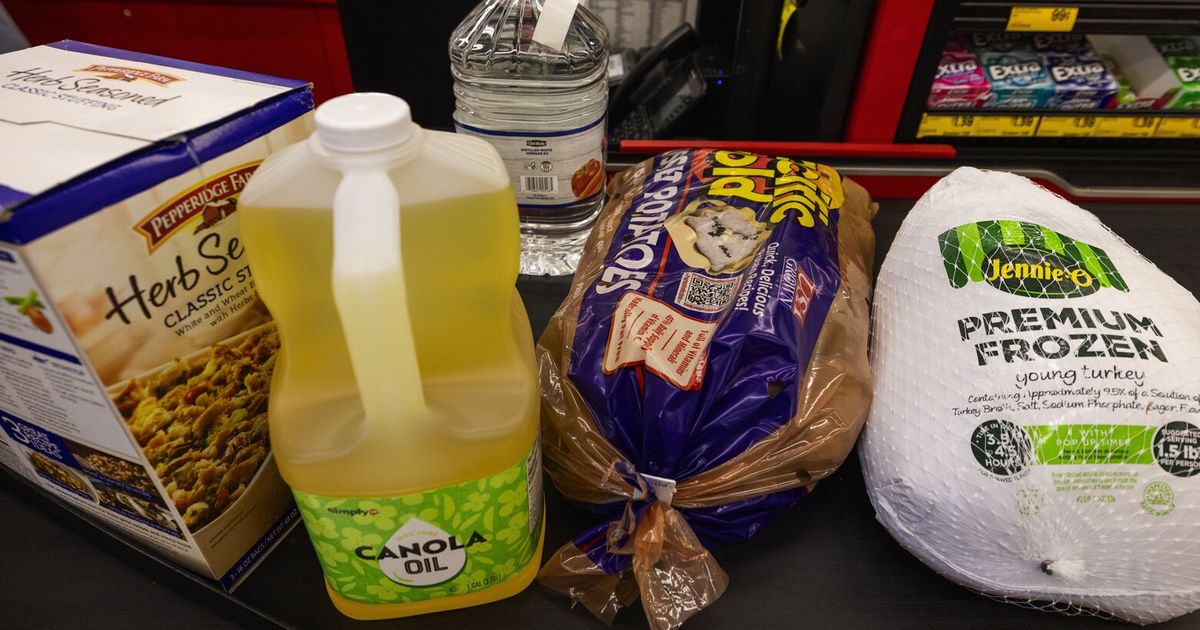
With Thanksgiving around the corner, families are drawing up menus, preparing grocery lists and starting to shop for the holiday.
But what they’ll pay at the checkout depends heavily on where they are in the nation, with those on the West Coast, including Seattle, likely to spend the most on Thanksgiving dinners.
The average price of a classic Thanksgiving dinner this year pencils out to $61.75 in the West, which includes Washington, according to a survey of grocery prices conducted by the American Farm Bureau Federation, an agriculture lobby group. That’s a nearly 8% decrease compared with the regional cost in 2024. But it’s higher than elsewhere in the country. The same meal prices out to $60.82 in the Northeast, $54.38 in the Midwest and $50.01 in the Southwest.
This year’s national average is 5% lower than 2024, in part due to cheaper turkeys — arguably the central expense of Thanksgiving dinner. According to the Farm Bureau, the average price of a 16-pound frozen turkey fell 16% from last year, in part due to Thanksgiving deals.
The Farm Bureau’s West region includes Alaska, Arizona, California, Colorado, Hawaiʻi, Idaho, Montana, Nevada, New Mexico, Oregon, Utah, Washington and Wyoming. But it doesn’t break down prices by state.
For a closer look at prices in Washington, we compiled online grocery prices set by location across seven cities: Seattle, Bellevue, Tacoma, Everett, Vancouver, Spokane and Bremerton.
We closely replicated the Farm Bureau’s grocery basket, which included a 16-pound turkey, green peas, pumpkin pie mix, cranberries, sweet potatoes and cube stuffing, among other items.
In each city, we took an average of prices from a local Safeway and a local QFC or Fred Meyer, which are owned by the same parent company, Kroger. For each item, we kept the brands identical when possible: Butterball for turkey, Franz for dinner rolls, Mrs. Cubbison’s for cube stuffing.
As it turns out, Thanksgiving dinner will probably be more expensive in Washington overall than in many neighboring states. And within Washington, you’ll probably find the highest prices in Seattle.
The average cost across the seven cities in Washington was $73. Our shopping cart in Seattle averaged out to nearly $76. That’s almost 10% more expensive than an identical shopping cart in Spokane, which cost less than $70.
Also on the lower end were Vancouver and Bremerton, where the same cart priced out to slightly over $70.
Because of the limitations of our survey, customers may be able to score lower prices if they pick different brands or use store deals.
No. 1 contributor
Higher prices in Seattle are partially a reflection of the higher cost of doing business in Seattle.
“It’s pretty expensive to find a place to put a grocery store in Seattle and then put the staff in it necessary to stack the shelves, pass the meat and seafood over the counter and run the checkouts,” said Chris Anderson, a professor at the University of Washington who teaches a class on the economics of sustainable food systems. “That is probably the No. 1 contributor to why grocery stores or why grocery prices are higher in Seattle in particular.”
Higher prices are also a product of higher incomes, said Jill McCluskey, director of the School of Economics at Washington State University. “Washington has higher income than a lot of other states, and so that means that we’re willing to pay more for food.”
The median household income for Washington in 2024 was $97,500 — the 12th-highest among all 50 states and the District of Columbia, according to the U.S. Census Bureau.
Fresh vegetables are significantly more expensive this year, according to the Farm Bureau survey, with prices driven up by natural disasters and lack of farmworkers.
“Even modest disruptions related to weather, labor shortages, transportation delays or regional production setbacks can translate quickly into short-term price spikes at retail,” wrote the survey authors.
On the other hand, there’s one item that will likely be an unexpected deal: turkey.
That’s because the bird is typically a loss leader for grocery stores, said McCluskey. Supermarkets usually price them below cost, hoping that such a deal will lure shoppers through the doors. Some stores even offer shoppers a free turkey if they hit a minimum spend on other items.
“It’s the centerpiece,” she said. Shoppers typically look for a deal on turkey, given that it’s such a central ingredient. “Then they’ll just buy everything from their whole list, and the store can still make money from all the little things with in aggregate.”


