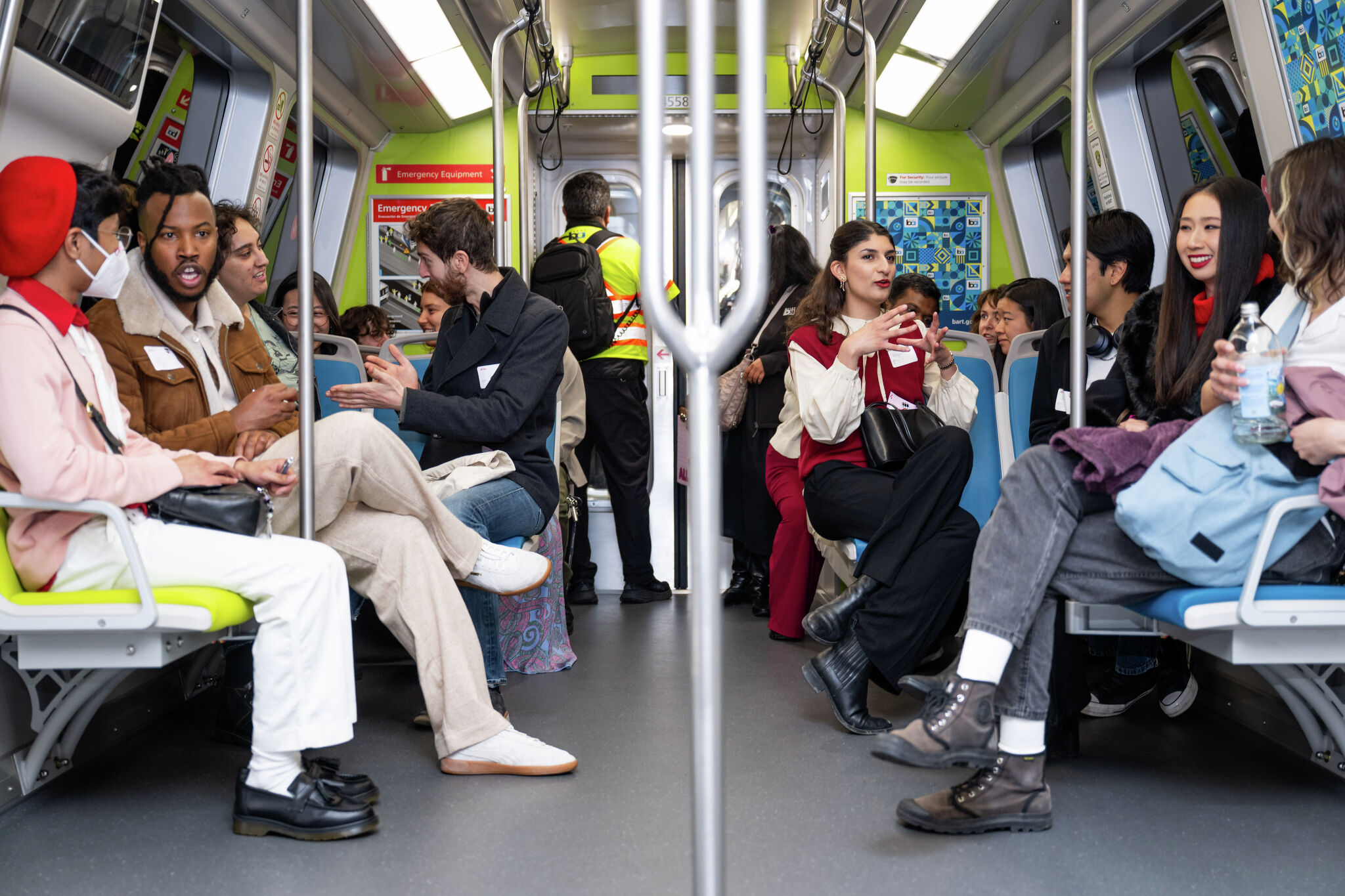
If it wants to survive, BART desperately needs our love. And baby, it ain’t too proud to beg.
With 14 statewide ballot measures set to crowd and confuse the November ballot, BART needs a different kind of strategy to convince Bay Area voters to approve a ballot measure that is critical to its survival: a charm offensive, including merch drops and theme parties at BART stations. And it might be working.
Article continues below this ad
BART has already reminded voters that this measure is existential, even if you don’t ride the trains like many of us do. If the measure fails, BART has said it could close 15 stations, upending life in the Bay Area and kneecapping the local economy. Without the trains, we would be flushed into our cars and every commute would seem like a gridlocked rush-hour slog from Modesto.
Passing this measure will be a larger, more complicated lift than many ballot measures.
BART needs voters in five very different counties in November to approve a ballot measure that would raise sales taxes by a half-cent in Alameda, Contra Costa, San Mateo and Santa Clara counties and by 1 cent in San Francisco.

Ren Fitzgerald, 18, wears a BART holiday sweater inside their dorm room on the UC Berkeley campus on Nov. 20, 2023. BART is appealing to transit superfans with kitschy swag in an effort to win back commuters.
That lift recently got heavier. Anti-tax sentiment is high in the Bay right now: Look at the measures that failed in San Francisco, Oakland, El Cerrito, Contra Costa County and elsewhere in the June 2 primary. And there will be a lot of outstretched hands on the ballot in November. Among the measures on the statewide ballot are one to extend the top marginal tax rates on high-income earners, set to expire in 2031; an expansion of the state’s rainy day fund; a statewide billionaire tax and two others designed to hinder it; and a property tax in San Francisco to help fund Muni.
Article continues below this ad
When voters are overwhelmed with too many or confusing ballot measures, they’ve historically defaulted to voting “no.” Early polls show 56% of voters supporting the BART measure — solid, but not the 60% cushion that proponents typically hope to hit at this point of the campaign, before having to repel any attacks against it.
Pollster Ruth Bernstein, who is working on behalf of the measure, told the Metropolitan Transportation Commission earlier this year that “more work needs to be done to figure out how we pull at people’s heartstrings.” My translation: It’s noble and smart to talk about how important public transportation is to addressing climate change and how traffic gridlock could increase if stations close. But BART needs a love connection to cut through the ballot clutter.
“We need to connect with voters,” Bernstein told me. “Many people do take transit, and they’re supposed to take transit. We want to remind them how important transit is.”
The good news for the transit system is that it’s been working on making an emotional connection with riders for years now — mostly to coax them back on the train after the pandemic emptied the system. The wooing began then with events and displays that BART’s publicists call “station activations.”
Now these activations have a new goal: the system’s survival.
Article continues below this ad

Participant Ashley Terry explains her piece “Remnants of a Festival Romance,” during Bart Basel 2022 in San Francisco on Dec. 3, 2022. The event was one of many the transit system hosted to lure back riders after the COVID-19 pandemic, a tactic it has continued to earn favor ahead of a crucial ballot initiative.
BART’s bet: It can talk about improved on-time performance and cleaner, safer trains all day, but nothing can top loving your local transit system, even in a kitschy, ironic way. In these days, when voter mistrust is high, creating a personal connection with voters is necessary. Ask New York Mayor Zohran Mamdani.
BART held a Valentine’s Day-related speed-dating event in February 2025 (which my colleague Emily Hoeven participated in). Its “Let’s Glow!” Anime Festival last year drew 5,000 people to its Warm Springs Station. Five thousand in Warm Springs! A similar event is planned for September there. BART’s wacky holiday sweater sale has become an annual tradition.
But nothing may top the BART love I witnessed at a recent 1980s-themed prom event I attended at the Rockridge BART parking lot with my wife.
Yes, it was her idea. I typically offer better options for Saturday night.
Article continues below this ad
As one of the few people in attendance who actually attended his prom in the 1980s, I initially bristled at the inaccurate cultural appropriation of my formative years. No, kids, we didn’t dance in a conga line to Billy Idol’s “Rebel Yell” back in the Reagan era. And no, contrary to the band’s set list, Alanis Morissette was not cranking out her angsty songs in the 1980s, and “Pink Pony Club” was way too progressive for most of my generation. And by the way, why was not one Clash song played during the show?
Still, I felt a powerful force. The BART love. It was flowing everywhere.
The longest line at the event was the queue for the photo booth in front of BART swag. Elsewhere, you could pose with an oversized BART ticket, buy transit-themed plush toys or take selfies in front of a BART map. This was not how I recall Saturday night fun in the 1980s, but I was trying to go with it.
I’m glad I did, because the real show of love flashed spontaneously. That’s when the largely under-40 crowd stopped dancing to a Duran Duran song when they heard the train pulling out of the station above them. They turned, looked skyward, and cheered and waved — at a BART train! They did this all night long.
No, it wasn’t the booze talking. None served — BART’s choice — though it could probably make some stations better-looking. Just endless gallons of Hawaiian Punch being poured (another cultural misstep: more of a ’70s thing for me).
Article continues below this ad
Regardless, 1,200 people paid $15 apiece to spend their Saturday night in a BART parking lot. Many of them were clad either in 1980s “costumes” (fact check: Only a Mötley Crüe-loving sliver of my generation wore spandex on a regular basis) or, this being a prom, some kind of formal wear.
That’s gotta be love. Or a sad commentary on Bay Area nightlife.
Most important for BART ballot measure proponents: The bald dude in the borrowed bow tie who experienced the 1980s in real time — me — was the oldest dude there. If BART has found the key to getting young people to love it to the point of voting, that will go a long way toward passing BART’s existential ballot measure in November.
But there are other challenges, namely from suburban voters who don’t support the ballot measure quite as much as voters in San Francisco, according to early polling.
“It’s always a challenge to meet those voter thresholds. There’s no doubt about it. I mean, you have to work hard for it,” said Amy Worth, former chair of the Metropolitan Transportation Commission and an Orinda resident (and ex-mayor) who supports the measure.
BART is part of Contra Costa’s history as cities grew and thrived around the BART stations. President Lyndon Johnson attended the groundbreaking of the Concord line in 1964. But that’s history. If BART wants to keep going steady in the Bay Area, it’s going to have to take a lot more voters to the prom.


