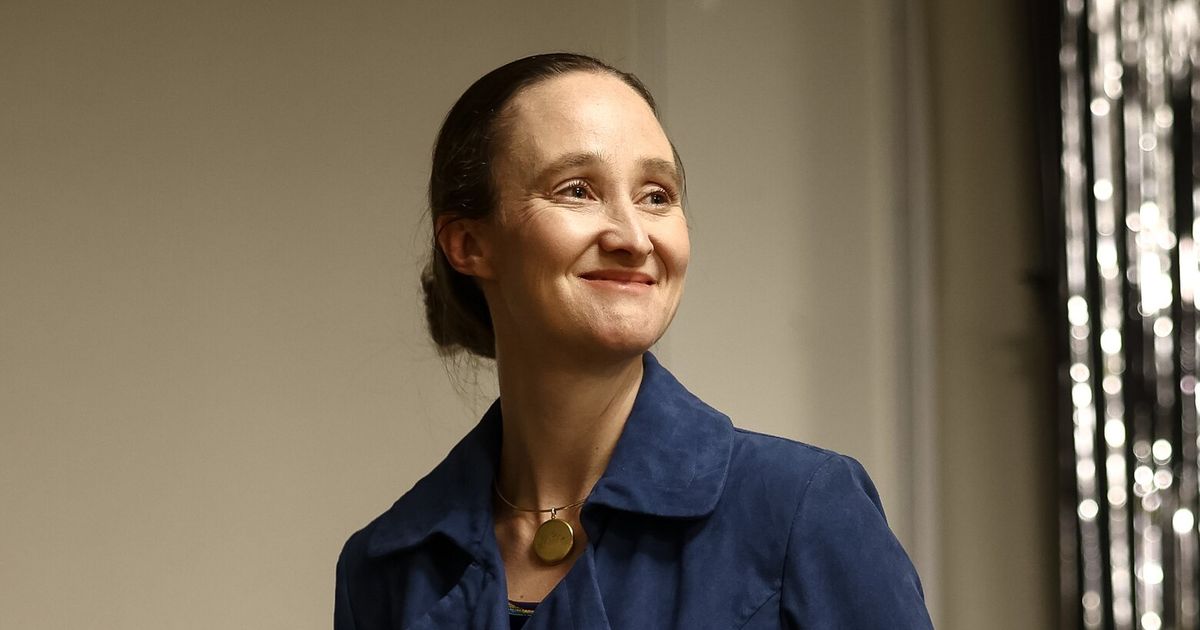
After trailing by more than 10,000 votes the day after the election, Wilson, 43, chipped away at Mayor Bruce Harrell’s margin as late-counted ballots broke her way. She took a tiny lead in Monday’s count, and with Tuesday’s additions, Wilson is now ahead by 1,346 votes.
The race could ultimately prove to be the closest in Seattle’s history. If the two candidates remain within 0.5% after the results are certified later this month, an automatic machine recount will be triggered. The race is barely within that margin now. If they are within 150 votes, the contest will go to a hand recount.
But with only 1,463 ballots remaining — plus however many challenged ballots are resolved — Wilson is now the clear favorite to be elected.
“We’re going to wait for all of the ballots to be counted, but I think we won this race,” Wilson said Tuesday.
A spokesperson for Harrell’s campaign said: “While not the direction we were hoping for, this remains a very close race, and we want to ensure every vote is counted.”
If Wilson indeed keeps the top spot in the coming days, her victory would represent a narrow rebuke of the city’s establishment political class, which Harrell, who’s been in City Hall for most of the last two decades, has come to represent.
Four years after an election that hinged almost entirely on public safety, Wilson intuited that affordability was quickly rising as a top issue and that voters were ready for a new face to lead the city’s response to homelessness.It appears her read on the electorate was correct, as she overcame broadsides about her managerial experience from Harrell on her way to this growing lead.
Should she indeed win, she would be the city’s most vocally progressive mayor since Mike McGinn was elected in 2009, having run her campaign on taxing corporations and spending aggressively to scale up temporary housing for the homeless. She’s promised 4,000 new shelter units in her first term, by far the most ambitious goal of any mayor before her.
She’s pledged more investment in police alternatives, faster action on bus lanes and other transportation modes and to open the doors for more housing in all neighborhoods.
“I really think this result reflects where this city and voters are actually at in terms of the vision they want to see going forward,” she said Tuesday.
For Harrell, a loss would represent an unceremonious end to a long career in City Hall.
Throughout his campaign, he sought to present himself as a steady hand in an unsteady time, who brought the city back from the chaos of the pandemic and protest years.
But while his showing in the general election was better than in the primary, his message that he, too, could be a change agent was a tough sell from the longest tenured person in city politics. For a decade, voters have been told homelessness is an emergency but have seen frustratingly slow progress. Harrell was in office for almost all of that time.
Wilson, with her police security detail now in tow, was greeted with a roar at Stoup Brewing’s Capitol Hill location Tuesday evening, as she arrived to a social gathering of the 43rd Legislative District Democrats. With her daughter, Josephine, at her hip, she moved through a procession of well-wishers excited to speak to the likely mayor-elect of Seattle.
She promised more details about her transition team and possible staffing plans next week. In the meantime, she was enjoying time with her daughter.
“I’m about to plunge into a very intense transition process and then into office,” she said in a brief interview. “I’ve just been trying to spend some time with the little one, and I think that the perspective that being a mom in this city gives me is really valuable.”
Wilson then took a moment to leave the crowd with her daughter to grab dinner from Noodle Cart food truck. With pop music and celebrations on the other side of the bar, and nearby patrons unaware of who she was, she sat with Josephine to read a book: “Annie the Anxious Pug.”
If confirmed the winner, Wilson, who founded the nonprofit advocacy organization, the Transit Riders Union, will face a significant job before her.
She would need to make crucial decisions about her administration, both who will work in her office and which department heads — for transportation, housing, utilities and more — should stay or go. Crucially: Does Shon Barnes, chief of the Seattle Police Department, get a shot under a mayor who’s previously called for a wholesale reimagining of public safety?
She would also inherit a budget that’s deeply out of whack. The 2026 ledger is balanced, barely, but a more than $140 million deficit looms for 2027. How she would approach that math equation in the coming year — by way of trying to raise new revenue or paring back programs without clear funding sources — would indicate exactly what sort of administration she intends to run.
Beyond her broader policy goals, Wilson would also face one immediate pressing need: The 2026 World Cup. Much of that work has been underway for years now, but it would be on her administration to usher the mega-event through to its completion next summer.
Wilson grew up in Binghamton, N.Y. The daughter of two biology professors, she was an activist from a young age — serving free food on the weekends, writing critically of her school, meeting her future husband at a protest of the treatment of circus elephants.
After graduating at the top of her high school class, she attended Balliol College at the University of Oxford for nearly four years. But six weeks before graduating, and shortly after a sojourn to Indonesia, she dropped out.
The decision disappointed her parents and was cast during the campaign as a choice only available to the privileged. But Wilson said it was a commitment: She was closing off a careerist path in favor of advocacy.
She and her husband, Scott Myers, moved to Seattle in 2004, in search of a way to change the world.
For years they took on low-wage work before founding the Transit Riders Union in 2011, in response to proposed cuts to Metro service. The organization grew into a force for economic populism that helped affect policy change in City Hall, including the 2020 JumpStart tax on large businesses like Amazon, and in nearby cities Burien and Tukwila.
That work unwittingly made Wilson a counterforce to Amazon’s growing presence, a rise that spoke to the resentment some felt about the poorly shared benefits of such prosperity. Over the past five years, she increasingly became the city’s voice for leftist politics — via opinion columns in several outlets around the city — even as she grappled with its shortcomings.
During the pandemic and protest years, Wilson and others backed calls to cut the city’s police budget. Harrell, whose success four years ago hinged on growing the department, sought to remind voters of this fact, arguing Wilson would bring the city backward.
But Wilson has said she’s grown since then and has pledged to continue the upward trend of new police officer hires while even promising more police presence in hot spot zones downtown and in the Chinatown International District.
President Donald Trump’s 2024 election helped reshape the race, both candidates agreed. Harrell contended he was a casualty of a broader vacuum of trust toward politicians; Wilson said he represented a failure of the Democratic establishment.
As a young progressive challenger to a significant figure in local politics, Wilson has drawn comparisons to Zohran Mamdani, the mayor-elect of New York City who has close ties to the Democratic Socialists of America. Wilson herself embraced that parallel on her social media channel, replicating his street-level videos of talking about the cost of living.
But while Wilson identifies as a socialist, she is not tied to any of the organizations pushing for a larger presence in city politics. In fact, the local chapter of the Democratic Socialists of America declined to publicly endorse her following a meeting in which she did not rule out removing homeless encampments from public spaces.
With the results of the mayor’s race finally coming into view, it’s clear that City Hall is once again a remade place. After the elections of 2021 and 2023 obliterated progressives in Seattle government, they have now made a strong return on the City Council and in the city attorney’s office.
That leaves a city government with few clear blocs. Though a Wilson administration would have allies, the path to major policy wins would not be easy.
Even as the vote counting continues, Wilson has been thinking about her transition. She may soon receive a city office, likely in the Seattle Municipal Tower. Mayors-elect generally have a few transition chairs, with a larger group of advisers and experts working below them. Often, many of the people who worked on the campaign stay on to work in the office.
“It’s been a contentious campaign and I think now is the moment we come together,” Wilson said. “As mayor, I’m going to be a mayor for everyone.”


