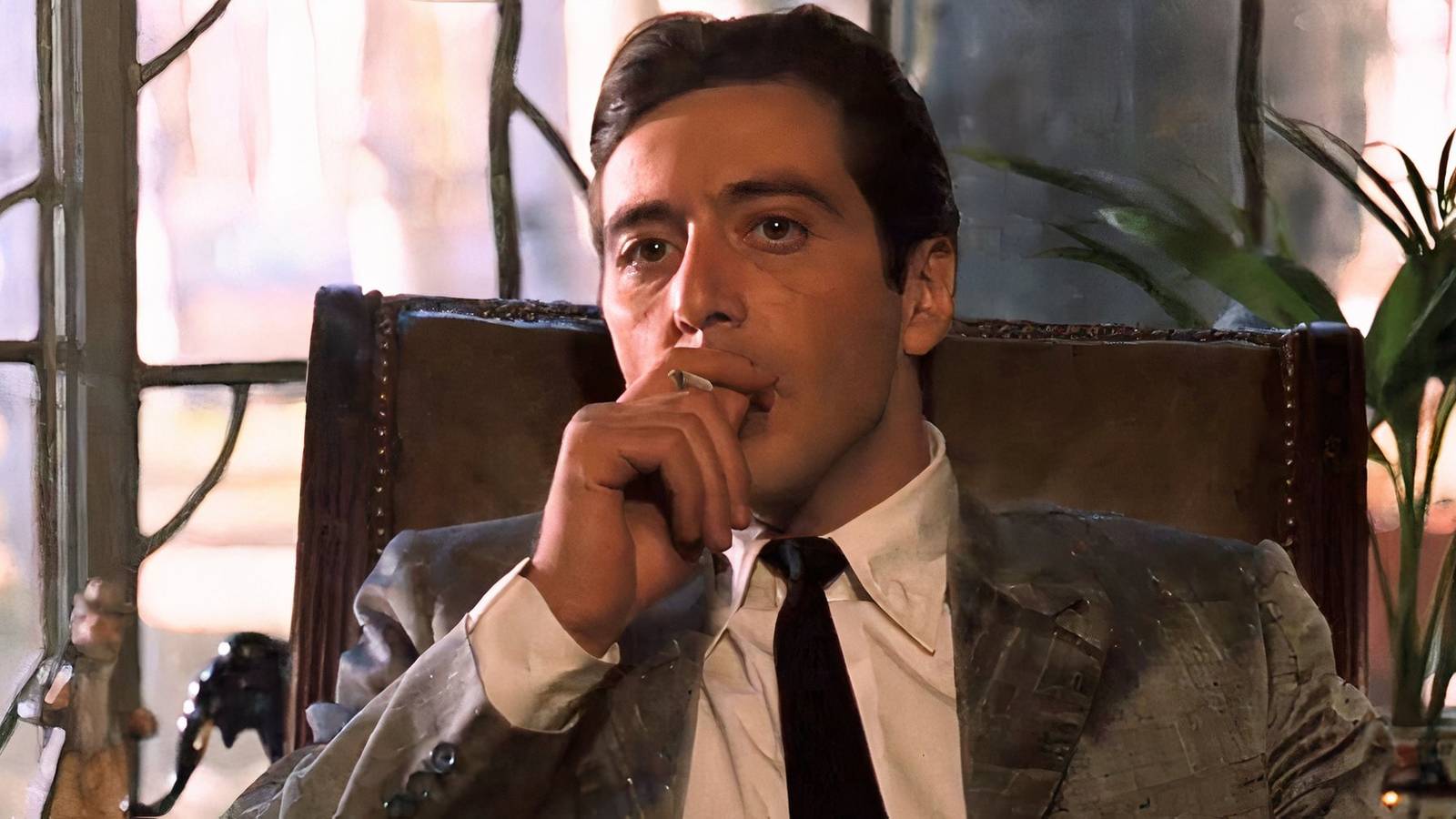
While noteworthy crime movies have been abundant over the last one hundred years, there is still a collection of films, such as On the Waterfront starring Marlon Brando, Once Upon a Time in America, and Quentin Tarantino‘s Pulp Fiction, that are considered by many to be some of the genre’s greatest masterpieces in American cinema. From the groundbreaking 1967 crime film, In the Heat of the Night, starring Sidney Poitier and Rod Steiger, to Francis Ford Coppola‘s Oscar-winning classic The Godfather, these are the ten greatest crime movie masterpieces over the last one hundred years, ranked!
10
‘In the Heat of the Night’ (1967)
In the Heat of the Night is based on John Ball‘s 1965 novel of the same name and stars Sidney Poitier as a Philadelphia detective, Virgil Tibbs, who is wrongfully accused of murder and robbery by local law enforcement in a small, racist Mississippi town. When Tibbs finally manages to clear himself of any wrongdoing, he feels that his superior knowledge and experience working homicide cases could be useful and offers to help the police chief, Bill Gillespie (Rod Steiger), with the investigation.
In the Heat of the Night pairs a compelling crime story with profound social relevance, making it both a landmark film of its time and a timeless crime masterpiece. Released during the height of the Civil Rights Movement, the film boldly confronts racism head-on, weaving social commentary directly into the crime narrative without losing suspense or momentum. Essentially, In the Heat of the Night redefined what a crime film could achieve: not just solving a mystery, but challenging audiences to reflect on justice in a broader moral and societal sense.
9
‘The Maltese Falcon’ (1941)

John Huston made his directorial debut with the best detective noir classic, The Maltese Falcon, which established the tropes of the genre and set the template that countless crime stories still follow today. Based on Dashiell Hammett‘s 1930 novel, Humphrey Bogart stars as a private investigator, Sam Spade, who is hired by a mysterious woman (Mary Astor) to find her sister, but as Spade conducts his investigation, he soon finds himself entangled with a group of shady characters who are all in search of a priceless statue known as the Maltese Falcon.
The Maltese Falcon created a new cinematic language for crime films, influencing generations of filmmakers and continuing to be a benchmark for the tone, style, and complexity of the genre. Bogie’s performance as Spade is not only recognized as one of the star’s signature roles but is also credited for setting the standard of the genre’s hard-boiled detective with his cool, calculating persona, quick wit, and sharp style. Unlike earlier, more straightforward heroes, Spade operates in a morally ambiguous world where trust is fragile, and motives are always suspect, introducing a level of psychological depth that has become a hallmark of great crime cinema.
8
‘On the Waterfront’ (1954)

Elia Kazan‘s 1954 crime classic, On the Waterfront, transforms a story about deep-seated corruption into a deeply human, emotionally powerful drama, making it one of the greatest crime movie masterpieces in the last one hundred years. The film follows a former up-and-coming boxer, Terry Malone (Marlon Brando), who now works as a longshoreman on the mob-run docks in Hoboken, New Jersey. When a fellow longshoreman is murdered before testifying against the powerful mob boss, Johnny Friendly (Lee J. Cobb), Malone decides to help the victim’s sister (Eva Marie Saint) find justice for her brother and, hopefully, to finally bring Friendly to justice.
On the Waterfront is celebrated for its raw realism and groundbreaking performances, notably by Brando, who went on to win the Academy Award for Best Actor. The crime element, union corruption and violence, is not just a backdrop, but a force that shapes every character’s choices and moral conflicts, ultimately transcending the traditional crime drama. On the Waterfront blends crime, character study, and social commentary into a gripping and emotionally resonant story that ultimately proves how crime films can be as introspective and meaningful as they are intense and suspenseful.
7
‘Double Indemnity’ (1944)
Billy Wilder‘s Double Indemnity is an essential film noir classic that perfected the genre’s formula with an array of memorable performances and a chilling, psychologically rich story about greed, desire, and deception. Fred MacMurray stars as Walter Neff, an insurance salesman who becomes romantically involved with a married woman, Phyllis Dietrichson (Barbara Stanwyck). When the couple removes Dietrichson’s wealthy husband from the picture, they make it appear like an accident to inherit his life insurance, but just when they think they’ve gotten away with murder, Neff’s associate, Barton Keyes (Edward G. Robinson), suspects that there’s more to Mr. Dietrichson’s sudden death.
One major reason why Double Indemnity has had such a lasting impact on the crime genre is Stanwyck’s performance, which helped define one of classic noir’s most enduring archetypes: the femme fatale. The electric chemistry between Stanwyck and MacMurray not only drives the film’s tension but also makes their characters’ descent into the world of crime feel both inevitable and tragic. Double Indemnity ranks as one of the greatest crime classics because it doesn’t glamorize crime like other films at the time. Instead, it shows how quickly ambition and lust can blind people from the bigger picture, leading them down a path of self-destruction with no point of return.
6
‘The Departed’ (2006)

The Departed is an American remake of Andrew Lau and Alan Mak‘s 2002 crime drama, Internal Affairs, and follows an intense game of cat-and-mouse set in Boston, Massachusetts. The film follows a rookie police officer, Billy Costigan (Leonardo DiCaprio), who goes undercover and is recruited by Boston’s powerful Irish mob boss, Frank Costello (Jack Nicholson). As Costigan works on gaining Costello’s trust and insight into his operations, he’s unaware that Costello has a mole of his own, Colin Sullivan (Matt Damon), inside the Massachusetts State Police force.
Martin Scorsese‘s The Departed delivers both edge-of-your-seat entertainment and a profound exploration of institutional corruption, suggesting that crime and law enforcement are more intertwined than they appear. The performances, particularly by DiCaprio, Damon, and Nicholson, are ultimately what elevate the film to cinematic brilliance, setting it apart from other modern crime movies. The Departed received several Academy Award nominations, including Best Actor for DiCaprio, two for Best Supporting Actor for Nicholson and Mark Wahlberg, and went on to win for Best Director, marking Scorsese’s first win in the prestigious category.
5
‘Once Upon a Time in America’ (1984)

Robert De Niro stars in Sergio Leone‘s crime masterpiece, Once Upon a Time in America, as David “Noodles” Aaronson, who, years later, returns to his old stomping grounds in New York, where he once had a profitable career working as a bootlegger in the city’s criminal underworld during the 1920s and 1930s. Through a series of flashbacks, Noodles looks back on his former life, conveying a journey of self-discovery all plagued by violence, betrayal, and loss.
Once Upon a Time in America departs from conventional crime storytelling with a nonlinear structure that moves fluidly between past and present, turning the story into a haunting exploration of innocence and regret. The film removes all the glitz and glam that audiences are used to seeing in traditional gangster movies and instead depicts a raw portrait of life in organized crime and exposes the emotional and moral devastation De Niro’s character endured. Rather than focusing solely on crime and power, Once Upon a Time in America reflects on the passage of time and the irreversible consequences of past choices, which gives the story a tragic weight that is rarely matched in the genre.
4
‘Goodfellas’ (1990)

Martin Scorsese’s Goodfellas is a flawless adaptation of Nick Pileggi‘s 1985 novel, Wise Guy, which tells the true story of Lucchese family associate, Henry Hill, played by Ray Liotta, detailing his rise to the top and inevitable downfall into Witness Protection. What sets Goodfellas apart from other crime movies is its perspective, which, instead of focusing on powerful crime bosses, shows the world through the eyes of someone on the inside, capturing both the allure and the inevitable collapse of that lifestyle.
Stylistically, Goodfellas was a cinematic innovation that broke down barriers with its dynamic camera work (like the famous long tracking shot through the nightclub), and the use of voiceover and music, which creates a fast-paced, immersive experience that mirrors the rush of being a wise guy. The overall performances are simply iconic and one of the film’s greatest strengths, especially by Joe Pesci, whose volatile, unpredictable portrayal of Tommy DeVito adds an edge of constant danger to the film and also earned Pesci the Oscar for Best Supporting Actor.
3
‘Pulp Fiction’ (1994)

Quentin Tarantino’s Pulp Fiction features a distinctive cinematic style that reshaped modern filmmaking and features detailed, memorable characters who are portrayed by an exceptional cast, including John Travolta, Samuel L. Jackson, and Uma Thurman. The movie breaks away from the genre’s traditional linear narratives and instead chooses a non-linear structure that weaves multiple stories together, turning a string of crime stories into a layered, almost puzzle-like experience that effectively keeps the audience engaged from start to finish.
The massive success of Pulp Fiction led many filmmakers to experiment with different story structures as well as dialogue-driven stories, igniting a cinematic revolution that changed the genre’s conventional blueprint. The movie received several Academy Award nominations, including Best Actor for Travolta, Best Picture, and Best Director, and went on to win for Best Original Screenplay. Pulp Fiction doesn’t just tell a great crime story; it demonstrates how crime stories can be told. Considering its bold structure, unforgettable dialogue, and cultural influence, there’s no denying that it is one of the most important crime masterpieces of the last century.
2
‘The Godfather: Part II’ (1974)

Al Pacino reprises his signature role as Michael Corleone in Francis Ford Coppola’s The Godfather: Part II, which is without question one of the most infamous crime movie masterpieces of all time. The movie picks up with the Corleone family, who have now moved West, where Michael is attempting to legitimize the family through a deal with one of his father’s former associates, Hyman Roth (Lee Strasberg). Meanwhile, the audience witnesses the early days of Vito Corleone (Robert De Niro) and his rise from humble beginnings to becoming one of the most powerful mob bosses of all time.
It’s very rare for a sequel to live up to its predecessor, but The Godfather: Part II is a rare exception that not only holds a candle to the first film but is also considered by many to be superior. The film’s dual narrative structure is perhaps its most ambitious quality, as it shows the evolution of the Corleone legacy by paralleling the father’s and son’s individual rise to power. While the first film is about ascension, The Godfather: Part II reveals Michael’s transformation into a colder, more ruthless leader, turning a classic gangster film into a Shakespearean tragedy about loss, paranoia, and control. Out of the film’s eleven Oscar nominations, The Godfather: Part II won six of its nominations, including Best Picture, Best Director, and Best Supporting Actor for De Niro.
1
‘The Godfather’ (1972)

Francis Ford Coppola’s The Godfather is the greatest crime movie masterpiece that transformed the traditional gangster story into a sweeping, emotionally rich epic about power, family, and morality, essentially redefining the classic tropes and cultural elements of the genre. Based on Mario Puzo‘s best-selling novel, Marlon Brando stars as the head of one of the most powerful crime families, Vito Corleone, who, after declining an offer to work with an up-and-coming narcotics man, is gunned down in the streets but miraculously survives. While the aging patriarch is recovering, his youngest son and decorated war hero, Michael (Al Pacino), decides to step up to protect his family, leading him to become his father’s unexpected successor as the head of the Corleone family.
The Godfather is far more than just a story of organized crime and violence and features unconventional themes such as family, honor, and loyalty, which make it an emotionally compelling film, even for those who aren’t drawn to crime films. Compared to other gangster movies, The Godfather provides a rare insight into why many immigrants, specifically Italians, felt that they had no other option but to turn to a life of crime as a means to survive and provide for their family, turning the hopeful American Dream into something dark and complex. The Godfather earned eleven Academy Awards, including Best Supporting Actor for Pacino, Robert Duvall, and James Caan, and Best Director, and went on to win three Oscars for Best Picture, Best Actor for Brando, and Best Adapted Screenplay for Coppola and Puzo.


